
Introduction
Losing a tooth can affect much more than your smile. Missing teeth may make it difficult to chew comfortably, speak clearly, and maintain good oral health. Over time, nearby teeth may shift, and the jawbone beneath the missing tooth can gradually shrink due to lack of stimulation.
Dental implants are considered one of the most reliable and long-lasting solutions for replacing missing teeth. They are designed to look, feel, and function like natural teeth while helping preserve the health of your jawbone.
Whether you have lost one tooth, several teeth, or all your teeth, dental implants may provide a comfortable and permanent solution. In this guide, you’ll learn everything you need to know about dental implants—from how they work and who can benefit from them to the treatment process, recovery, and long-term care.
If you’re considering dental implants in Mohali, learn more about our comprehensive treatment options on our Dental Implants Clinic in Mohali page.
What Are Dental Implants?
Dental implants are artificial tooth roots made from biocompatible titanium, a material that is well accepted by the human body. They are surgically placed into the jawbone to support replacement teeth.
A dental implant consists of three parts:
- Implant: A titanium post placed inside the jawbone.
- Abutment: A connector that joins the implant to the replacement tooth.
- Dental Crown: A custom-made artificial tooth that restores appearance and function.
Over time, the implant naturally bonds with the jawbone through a process called osseointegration. This creates a strong and stable foundation for the replacement tooth.
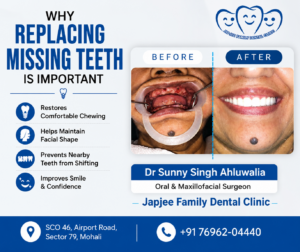
Real patient before and after dental implant treatment. Individual results may vary.
Why Is It Important to Replace Missing Teeth?
Many people believe that losing a single tooth is only a cosmetic concern. In reality, missing teeth can affect your overall oral health.
Replacing missing teeth may help:
- Restore comfortable chewing.
- Improve speech.
- Prevent nearby teeth from shifting.
- Maintain proper bite alignment.
- Preserve jawbone health.
- Support facial appearance.
- Improve confidence while smiling.
Who Is a Suitable Candidate for Dental Implants?
Dental implants may be suitable for many adults who have one or more missing teeth.
You may be a suitable candidate if you:
- Have one or multiple missing teeth.
- Have healthy gums.
- Have adequate jawbone to support an implant.
- Maintain good oral hygiene.
- Are generally in good overall health.
A detailed clinical examination along with digital X-rays or a CBCT scan helps your dentist determine whether dental implants are the right treatment for you.
Types of Dental Implants
| Implant Type | Best Suited For |
| Single Tooth Implant | Replacing one missing tooth |
| Multiple Dental Implants | Replacing several missing teeth |
| Implant-Supported Bridge | Replacing adjacent missing teeth |
| Full Mouth Dental Implants | Replacing all teeth in one or both jaws |
Your dentist will recommend the most suitable option based on your oral health and treatment goals.
Step-by-Step Dental Implant Treatment
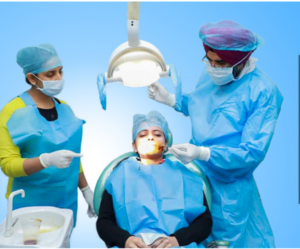
Dr. Sunny Singh Ahluwalia performing a dental implant procedure at Japjee Family Dental Clinic, Mohali. Dental implants provide a long-lasting solution for replacing missing teeth while restoring function and aesthetics.
Step 1 – Consultation
Your dentist evaluates your oral health, discusses your concerns, and recommends suitable treatment options.
Step 2 – Clinical Examination
Digital X-rays and CBCT scans help assess bone quality and plan implant placement accurately.
Step 3 – Treatment Planning
A personalised treatment plan is prepared based on your oral condition.
Step 4 – Implant Placement
The titanium implant is carefully placed into the jawbone under local anaesthesia.
Step 5 – Healing Period
The implant gradually fuses with the jawbone through osseointegration. This healing process generally takes 3 to 6 months.
Step 6 – Abutment Placement
Once healing is complete, the connector (abutment) is attached to the implant.
Step 7 – Final Crown Placement
A custom-made crown is fixed to restore the appearance and function of your natural tooth.
Looking for a personalized treatment plan? Visit our Dental Implants Specialist in Mohali page to understand the procedure, available implant options, and schedule a consultation.
Benefits of Dental Implants
Dental implants offer several long-term benefits, including:
- Natural appearance.
- Comfortable chewing.
- Improved speech.
- Stable replacement for missing teeth.
- Preservation of jawbone.
- Long-lasting solution.
- Better oral health.
- Enhanced smile and confidence.
If you have one or more missing teeth, our Dental Implant Treatment in Mohali can help restore your smile, chewing ability, and confidence.
Is Dental Implant Surgery Painful?
This is one of the most common questions patients ask.
Dental implant surgery is usually performed under local anaesthesia, making the procedure comfortable. Most patients experience only mild discomfort after treatment, which can usually be managed with prescribed medications and post-operative care.
Recovery After Dental Implant Surgery
Recovery varies from person to person, but many patients recover quickly.
| Time | What to Expect |
| Day 1 | Mild swelling or discomfort |
| 2–3 Days | Most patients return to routine activities |
| 1 Week | Soft tissue healing continues |
| 3–6 Months | Implant integrates with the jawbone |
Following your dentist’s instructions can help support proper healing.
Are There Any Risks?
Like any surgical procedure, dental implant treatment carries some risks, although complications are uncommon when performed after proper evaluation and planning.
Possible risks may include:
- Infection.
- Swelling.
- Delayed healing.
- Implant failure (rare).
- Increased risk in smokers.
Regular follow-up visits help monitor healing and support long-term success.
How Long Do Dental Implants Last?
Dental implants are designed to be a long-term tooth replacement option.
With good oral hygiene and regular dental check-ups, the implant itself may last for many years and, in many cases, a lifetime. The dental crown attached to the implant may require replacement after approximately 10 to 15 years, depending on wear and individual factors.
What Affects the Cost of Dental Implants in Mohali?
The cost of dental implant treatment varies depending on individual needs.
Factors that may influence the treatment cost include:
- Number of implants required.
- Type of implant system used.
- Bone grafting (if needed).
- Sinus lift procedures.
- Type of dental crown.
- Complexity of the treatment.
A consultation allows your dentist to provide a personalised treatment plan and estimate based on your clinical condition.
Dental Implants vs Dentures
| Dental Implants | Dentures |
| Fixed in the jawbone | Removable |
| Feel similar to natural teeth | May move during eating |
| Help preserve jawbone | Do not preserve bone |
| Comfortable chewing | Reduced chewing efficiency |
| Long-term solution | May require periodic adjustments |
How to Care for Dental Implants
Good oral hygiene plays an important role in maintaining dental implants.
Your dentist may recommend:
- Brushing twice daily.
- Cleaning between teeth using floss or interdental brushes.
- Regular professional dental cleanings.
- Routine dental check-ups.
- Avoiding tobacco use.
- Following personalised oral hygiene instructions.
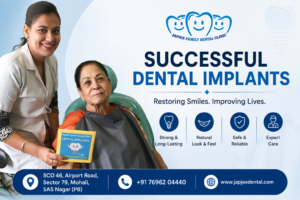
Real patient after successful dental implant treatment at Japjee Family Dental Clinic, Mohali.
Why Choose Japjee Family Dental Clinic?
At Japjee Family Dental Clinic, patient care is centred on personalised treatment planning and evidence-based dentistry.
Patients receive:
- Comprehensive dental evaluation.
- Modern diagnostic imaging.
- Personalised treatment plans.
- High standards of sterilization and infection control.
- Guidance before, during, and after treatment.
- Ongoing follow-up care to support long-term oral health.
Explore our Dental Implants Services in Mohali to see how our experienced implant team helps patients achieve long-lasting, natural-looking smiles.
Frequently Asked Questions
What are dental implants?
Dental implants are titanium tooth roots that support artificial teeth and help restore function and appearance.
Who is the right candidate for dental implants?
Most adults with missing teeth, healthy gums, and adequate jawbone may be suitable candidates after clinical evaluation.
Are dental implants permanent?
Dental implants are designed as a long-term solution. With proper care, they may last for decades.
Is dental implant surgery painful?
The procedure is usually performed under local anaesthesia, and most patients report only mild discomfort afterwards.
How long do dental implants last?
With proper oral hygiene and regular dental visits, dental implants can remain functional for many years.
What is the recovery time?
Many patients resume routine activities within 1–3 days, while complete healing generally takes 3–6 months.
Can smokers get dental implants?
Yes. However, smoking increases the risk of implant failure. Quitting before and after treatment can improve healing and success.
Are implants better than dentures?
Dental implants are fixed, stable, and help preserve jawbone, whereas dentures are removable and do not provide the same level of support.
How should I care for dental implants?
Brush twice daily, clean between teeth, attend regular dental check-ups, and maintain good oral hygiene.
Book a Consultation
If you’re considering dental implants or would like to explore your options for replacing missing teeth, schedule a consultation at Japjee Family Dental Clinic, Mohali. A detailed clinical examination can help determine the most suitable treatment plan based on your oral health and individual needs.
Medical Disclaimer: This guide is intended for educational purposes only and should not be considered a substitute for professional dental advice, diagnosis, or treatment. Individual treatment recommendations may vary. Please consult a qualified dentist or oral surgeon for an evaluation based on your specific oral health needs.
Ready to replace missing teeth? Visit our Dental Implants Mohali page to book your consultation with Dr. Sunny Singh Ahluwalia and learn about your treatment options

About the Medical Reviewer
Dr. Sunny Singh Ahluwalia is an Oral & Maxillofacial Surgeon at Japjee Family Dental Clinic, Mohali, with 25+ years of experience in dental implant surgery, wisdom tooth removal, oral surgical procedures, and comprehensive treatment planning. He is committed to providing evidence-based, patient-focused care while helping patients make informed decisions about their oral health.
Clinic: Japjee Family Dental Clinic
Location: SCO 46, Airport Road, Sector 79, Mohali, Punjab 140308